
Introduction
Hair loss is a prevalent concern among both men and women, often associated with factors such as genetics, hormonal changes, stress, and underlying health conditions. Among the various treatment options available, minoxidil is widely used to promote hair regrowth and manage certain types of hair loss. This blog provides a comprehensive overview of minoxidil for hair growth, covering its mechanism of action, effectiveness, expected results, recommended usage, and potential side effects.
What is Minoxidil?
Minoxidil (2,4-diamino-6-piperidinopyrimidine 3-oxide), a pyrimidine N-oxide, often known as Rogaine, is a pharmaceutical compound widely used for the treatment of hair loss and severe refractory hypertension.
Minoxidil was first introduced as an oral medication for the treatment of severe and recalcitrant hypertension in the 1970s.Coincidentally, physicians observed hair regrowth and generalized hypertrichosis in balding patients, which led to the development of a topical minoxidil formulation for treating androgenetic alopecia (AGA) first in male and then in female individuals.
Minoxidil is an active ingredient in FDA-approved topical hair regrowth formulations, including solutions and foams applied directly to the scalp. It works by stimulating hair follicles, promoting hair growth and slowing hair loss. Along with its dermatological applications, oral Minoxidil is prescribed for severe resistant hypertension. As a potent vasodilator, it relaxes blood vessels, improves blood flow and helps lower blood pressure.
How Does Minoxidil Work for Hair Growth?
The exact mechanism through which minoxidil promotes hair growth is still being researched, scientific research has identified many biological processes that help it in its effectiveness.. From enzymatic activation and improved blood circulation to the regulation of hair follicle activity , these mechanisms provide valuable insights into how minoxidil stimulates hair regrowth. Let’s explore the science behind its action.
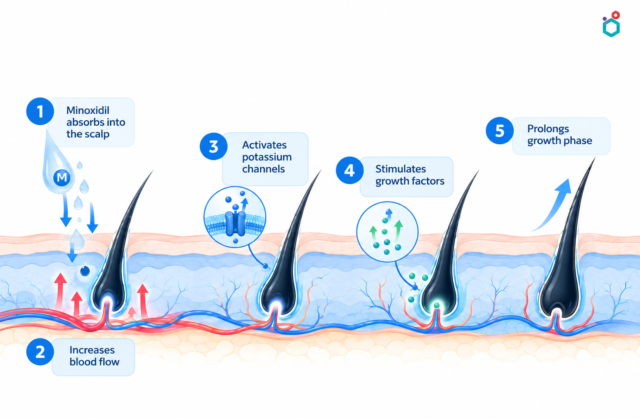
Minoxidil stimulates hair growth through several interconnected biological mechanisms, including enzymatic activation, potassium channel opening, improved blood circulation, regulation of the hair growth cycle, and modulation of cellular signaling pathways.
1. Enzymatic Activation of Minoxidil
Minoxidil undergoes enzymatic conversion into its active metabolite, minoxidil sulfate, through sulfotransferase enzymes, particularly SULT1A1, present in the outer root sheath of hair follicles.Minoxidil sulfate is primarily responsible for the hair growth-promoting activity of the drug.
2. Activation of ATP-Sensitive Potassium (KATP) Channels
Minoxidil sulfate activates ATP-sensitive potassium channels, contributing to vascular smooth muscle relaxation and vasodilation.
- Membrane Hyperpolarization: Opening potassium channels promotes potassium ion efflux, resulting in hyperpolarization of vascular smooth muscle cells.
- Reduced Calcium Influx: Hyperpolarization decreases the opening of voltage-dependent calcium channels, lowering intracellular calcium concentrations.
- Vasodilation: Reduced calcium availability relaxes vascular smooth muscle, potentially increasing blood flow around hair follicles.
Although vasodilation is an established pharmacological effect of minoxidil, its contribution to hair regrowth is not fully understood.
3. Regulation of the Hair Growth Cycle
Minoxidil influences different stages of the hair growth cycle, supporting follicular activity and improving hair density.
- Telogen-to-Anagen Transition: Minoxidil encourages hair follicles to move from the resting phase (telogen) into the active growth phase (anagen). This transition can lead to temporary hair shedding during the initial stages of treatment.
- Prolongation of the Anagen Phase: It helps maintain follicles in the active growth phase for longer, allowing continued hair shaft production.
- Improvement in Follicular Miniaturization: Minoxidil can increase hair shaft diameter in miniaturized follicles, helping produce thicker, more visible hair.
4. Modulation of Molecular Signaling Pathways
Minoxidil also influences several cellular signaling mechanisms associated with hair follicle growth, survival and regeneration.
- VEGF Expression: Minoxidil can stimulate vascular endothelial growth factor (VEGF) expression in dermal papilla cells, potentially supporting blood vessel formation around hair follicles.
- Prostaglandin E2 (PGE2) Production: Experimental studies suggest that minoxidil may promote PGE2 synthesis through cyclooxygenase-related pathways, which can contribute to hair growth regulation.
- Cell Survival Signaling: Minoxidil has been associated with activation of ERK and Akt signaling pathways in laboratory studies. These pathways can support dermal papilla cell surviva and reduce apoptosis (programmed cell death)
Who Can Benefit from Minoxidil for Hair Growth?
Minoxidil is primarily used to treat androgenetic alopecia (male and female pattern hair loss). It is generally more effective in individuals with early-stage hair thinning, where hair follicles remain active and capable of producing new hair.However, minoxidil research suggests that it might be less effective in cases of advanced baldness and cannot restore hair growth where follicles are permanently destroyed, as in scarring alopecia. Hair loss caused by nutritional deficiencies or thyroid disorders may require treatment of the underlying condition.Results vary depending on the type and severity of hair loss, follicular response, and treatment consistency.
How long does Minoxidil take to work?
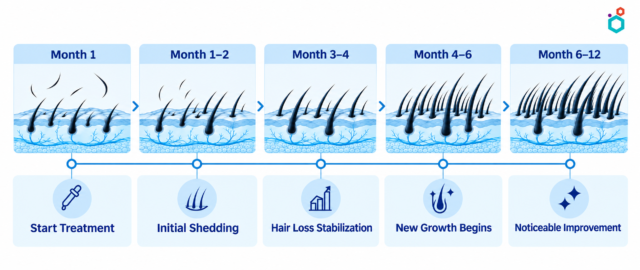
Minoxidil stimulates hair follicles and prolongs the anagen (growth) phase, promoting hair regrowth. Visible results typically appear within 3–6 months of consistent use, although individual results may vary.
First 2–8 Weeks – Initial Shedding: Some users may experience temporary minoxidil shedding as hair follicles transition from the resting (telogen) phase to the active growth phase.
2–4 Months – Early Hair Regrowth: Fine, new hair strands can begin to appear as follicles enter the active growth phase.
4–6 Months – Visible Improvements: Hair thickness, density, and scalp coverage may gradually improve with consistent application.
6–12 Months – Continued Hair Growth: Further improvements in hair thickness, density, and overall coverage may become noticeable.
Long-Term Use – Maintaining Results: Continued minoxidil use is generally necessary to maintain hair regrowth, as discontinuation may lead to gradual loss of newly regrown hair.
How to Use Minoxidil Correctly ?
Minoxidil is commonly available as 2% and 5% topical solutions and foam formulations. Proper application and consistent use are essential for effective hair regrowth.
- Clean and Dry Scalp: Apply minoxidil to a dry scalp for proper absorption.
- Use the Recommended Dose: Topical solutions are commonly applied at 1mL twice daily, while foam dosage and frequency vary by product. Follow the label or dermatologist’s instructions.
- Apply Directly to the Scalp: Part the hair and apply minoxidil to the affected areas rather than the hair strands.
- Allow It to Dry: Let the product dry completely and avoid washing the scalp for approximately four hours, unless otherwise directed.
- Wash Your Hands: Wash thoroughly after application to prevent unwanted hair growth elsewhere.
Consistent application is important, as using more than the recommended amount will not accelerate hair growth and can increase side effects.
What Happens If You Stop Using Minoxidil?
Stopping minoxidil gradually reverses its hair growth benefits, as the treatment no longer supports the active anagen (growth) phase of hair follicles. Hair regrown or maintained through minoxidil treatment may begin shedding within 3–4 months after discontinuation.
Over time, hair density and thickness may decrease, and the underlying hair loss condition, such as androgenetic alopecia, may continue to progress. Consistent, long-term use is generally necessary to maintain minoxidil-induced hair regrowth.
Minoxidil Side Effects: Common Risks & Safety Precautions
Minoxidil is generally well tolerated when used as directed, but it may cause certain side effects depending on the formulation, dosage, and individual sensitivity. Topical minoxidil side effects are usually mild and affect the scalp, while oral minoxidil carries a higher risk of systemic effects.
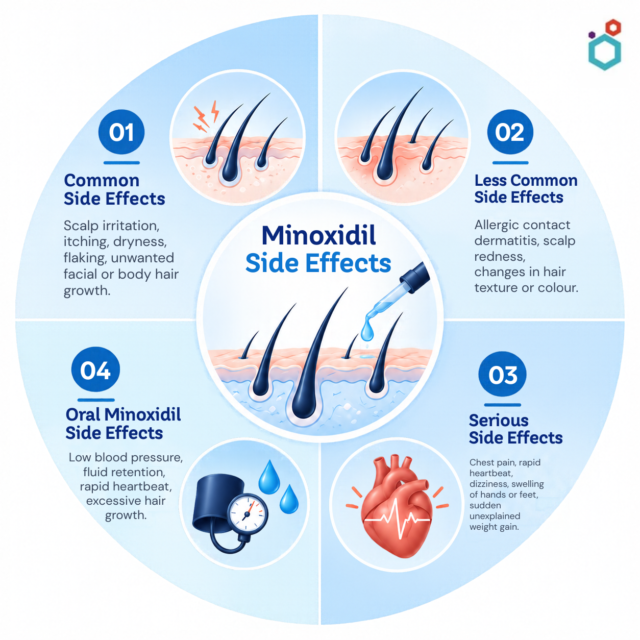
- Common Minoxidil Side Effects: Scalp irritation, itching, dryness, flaking, and unwanted facial or body hair growth (hypertrichosis).
- Less Common Side Effects: Allergic contact dermatitis, scalp redness, and changes in hair texture or colour.
- Serious Minoxidil Side Effects: Chest pain, rapid heartbeat (tachycardia), dizziness, swelling of the hands or feet, and sudden unexplained weight gain. Stop topical minoxidil and seek prompt medical attention if these occur. Chest pain or fainting requires emergency care.
Oral Minoxidil Side Effects: Low blood pressure (hypotension), fluid retention (edema), tachycardia, and excessive hair growth. Oral minoxidil for hair loss requires medical supervision due to potential cardiovascular risks.
FAQs
Q. Is Minoxidil safe?
Minoxidil is a medicine for hair loss in men and women that has been approved by Health Canada and the US FDA. Topical preparations containing 2% and 5% of the medication are available. This OTC medication is regarded as safe; however, it should be used with caution.
Q.What is the effectiveness of Minoxidil for women?
Minoxidil is the only drug that is FDA-approved to treat female pattern baldness. It slows down or stops hair loss by prolonging the growth phase of the hair follicles.
Q.How to use minoxidil?
Minoxidil is a promising treatment for hereditary hair loss and androgenetic alopecia. A 5% minoxidil solution should be applied to a clean, dry scalp and gently massaged into the affected areas. After application, allow the scalp to remain dry for 2–4 hours for optimal absorption.
Q.Is minoxidil safe for hair?
Minoxidil is safe and FDA-approved and is widely used as a topical treatment for hair growth. However, it is always advisable to use it only on the recommendation of a healthcare professional, as some individuals may experience side effects.
Q.Who should avoid using minoxidil?
Minoxidil is a vasodilator and may cause problems in people with a history of heart disease. Individuals with eczema or known hypersensitivity to the medication, as well as women who are pregnant or breastfeeding, should also avoid using it.
Q.How long does minoxidil take to work?
Minoxidil does not work immediately; it generally takes 6–8 weeks to start showing effectiveness. However, results depend on the individual, and visible improvement typically appears within 3–6 months of consistent use.
Q.Does minoxidil work for a beard?
Minoxidil is well known as an effective treatment for scalp hair growth, and clinical studies show that it can also help to promote beard growth.
Q.What happens if I stop using minoxidil?
Any hair you gained or kept thanks to minoxidil will gradually be lost, and your hair will return to the path it would have followed without treatment. This is not permanent damage. It is the loss of a benefit that depended on continued use.
Q.How to apply minoxidil foam vs. solution?
Minoxidil foam is applied directly to a dry scalp and gently massaged into the affected areas, while minoxidil solution is applied using a dropper for precise application. Both should be applied to a clean, dry scalp as directed on the product label. Allow minoxidil to dry completely and wash your hands after application.
Disclaimer
The information provided in this blog is for general informational and educational purposes only and is based on publicly available scientific literature, research publications, and other reference sources. Macsen Laboratories does not guarantee the accuracy or completeness of this information. The content should not be considered medical advice or a recommendation for treatment. Consult a qualified healthcare professional before using Minoxidil or any hair growth treatment.
Send us your enquiry-
(or drop us a mail at sales@macsenlab.com, marketing@macsenlab.com)