
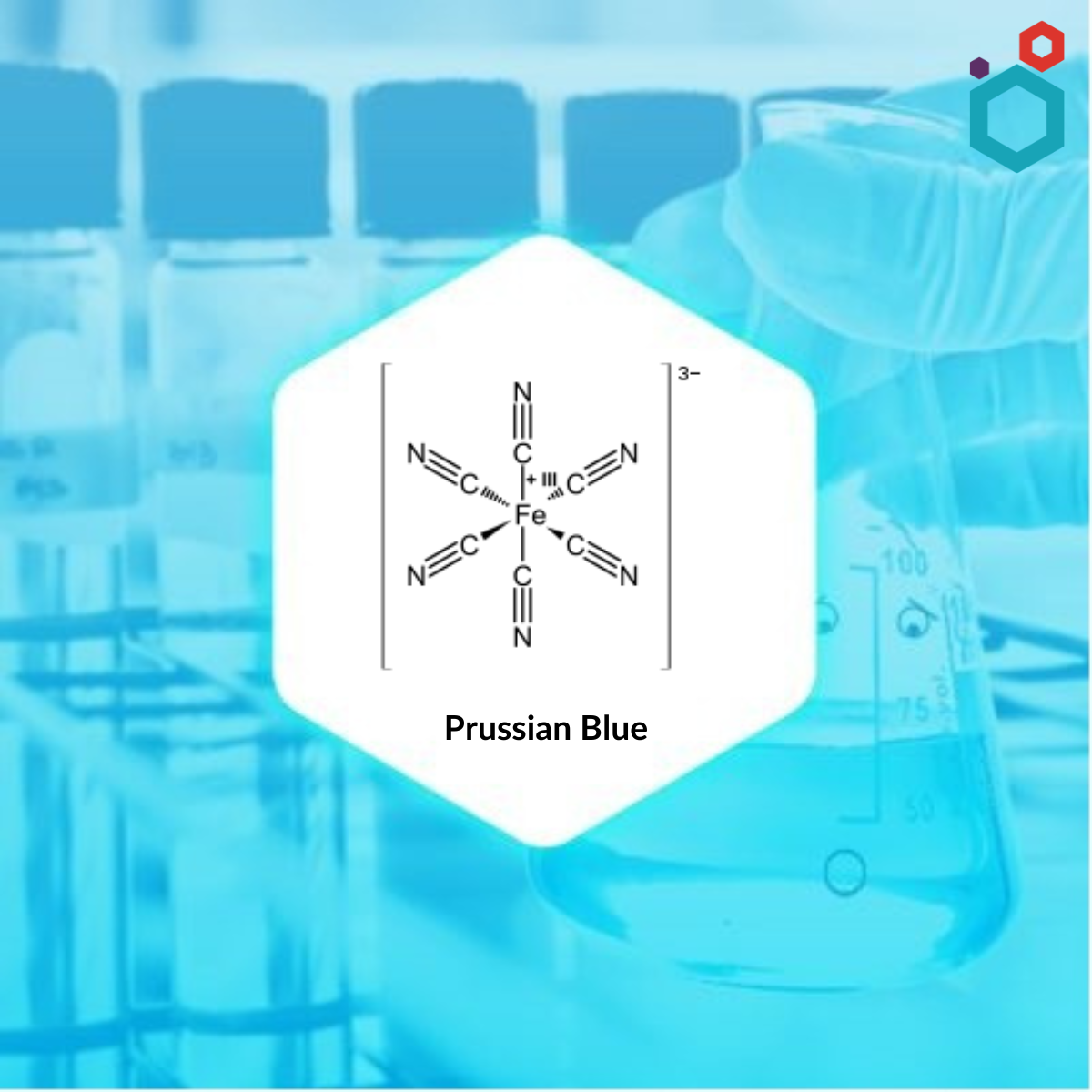
Home » Speciality Dyes and Biological Stains » Prussian Blue
Prussian blue, often called Berlin blue, Brandenburg blue, or Parisian or Paris blue in painting, was at first developed as a pigment for use in paint and ink. The name Prussian blue dates back to the 18th century, when the chemical was used to color the coats of Prussian army uniforms. It occurs as a microcrystalline blue powder.
| PRODUCT SPECIFICATIONS | |
|---|---|
| Name of Product | Prussian Blue Dye |
| IUPAC Name | iron(2+);iron(3+);octadecacyanide |
| Synonyms | Ferric Ferrocyanide; iron(III) hexacyanoferrate(II); Ferrocin; Parisian blue; Preussischblau; Turnbulls Blau; Berliner Blau; Brandenburg blue; Berlin blue; Sarum blue; Midnight blue |
| CAS No | 14038-43-8 |
| Molecular Formula | C18Fe7N18 |
| Molecular Weight | 859.2 g/mol |
| Pubchem CID | 2724251 |
| Pubchem SID | 475523906 |
| SR. No | Criteria | Limit/Specification |
|---|---|---|
| 1 | Appearance (Form) | Solid Powder |
| 2 | Appearance (Colour) | Deep Blue |
| 3 | Bulk Density | 0.4% |
| 4 | Specific gravity | 1.6 |
| 5 | Volatile matter | Not more than 1% |
| 6 | pH Value | Not less than 5 |
Because of its strong coloration, Prussian Blue is often compared with other blue pigments.
Phthalo Blue vs Prussian Blue
Ultramarine vs Prussian Blue
Q. What Color is Prussian Blue?
Prussian Blue is a deep, intense blue color that appears dark navy or slightly greenish blue depending on particle size and formulation.
Q. Is Prussian Blue Warm or Cool?
In color theory, Prussian Blue is generally considered a cool blue pigment because it contains subtle green undertones that shift the color spectrum toward cooler hues.
Prussian Blue as an Antidote for Radioactive Poisoning
Prussian Blue Analogues | Use in Sodium-Ion Batteries